Wednesday, August 18, 2010

Strategic Marketing Plan: Go In With a Game Plan!

It shouldn’t come as a surprise to you that if you want business success, you have to have a marketing strategy–a specific outline of your goals and how to achieve them.  What you may not know, especially if you’re just breaking into ecommerce, is what specific issues your marketing strategy needs to address in order for you to be competitive in today’s online business arena.  Following are a few important considerations, some specific to Internet marketing, others useful all-around.
What are you selling?
Sounds pretty straight-forward, right?  So straight-forward, in fact, that many people overlook it.  Clearly defining your product is the first step in creating a marketing strategy.  The goal of all businesses is to sell something, and concretely delineating what your product is–and isn’t–will help you stay focused as you make more advanced marketing decisions.  In ecommerce, having a firm concept of your product is especially important, as you’ll need strong keywords related to the product in order to develop effective advertising.

What’s your Unique Selling Point?

All advertising campaigns should have a Unique Selling Point–a persuasive argument that clearly states what you offer, what the customer will to gain by purchasing it, and why your offer is better than your competitors’.
A Unique Selling Point answers the question, “Why should people buy from you?”  It sets your business apart from the competition by making a claim that your rivals can’t match.  It shouldn’t just be an empty phrase, however; it should be a promise to the customer, one that you can deliver, and that you work to deliver by developing a strong marketing strategy.

How good is your offer?

Be honest with yourself.  How does your product compare with those of competitors?  What are its strengths?  Its weaknesses?  If you can improve on your offer in some way, that should be the focus of your marketing strategy; if your product is already competitive, then you need to work on selling it to your potential clients.

How easy is it to buy from you online?

Customer satisfaction is one of the key goals of any marketing strategy, and the easier it is for customers to buy from you, the more satisfied they will be.  Speed and options are key here.  The more payment and shipping options you have, the more customers you can serve, and the faster you can get an order to them, the more likely they are to come to you with future orders.

Where should you be advertising?

The Internet abounds with worthwhile advertising venues, but picking the right one for your web site can be difficult.  SEO practices and ad networks such as AdWords offer a good, general approach to advertising; however, your investment will generate a much greater return if you target customers specific to your niche through social marketing and direct partnership banner advertising, as well.  For these two approaches, it pays to learn about web analytics.

Marketing Process that Will Generate Massive Exposure for Your Online Business

Let’s spend a few minutes focusing on perhaps the most important principle in creating a successful online business– your strategic marketing plan.  A lot of people are intimidated by internet marketing because there is so much competition in many large niches such as network marketing, coaching, consulting, and information marketing.  As an online marketing coach, I can’t tell you how many times I have heard statements like:
  • I just don’t feel like there’s any room for me.
  • Who would want to hear what I have to say?
  • I can think big, but I have no idea how to take appropriate action
  • I have a website, but only have 20 people on my list
  • I have a website; isn’t that enough?
What I am about to share with you will give you an incredible competitive advantage and will serve as the ultimate answer to every single one of these statements, so that you never feel lost in the online world again.

Yes, the internet is absolutely packed with business owners competing for valuable online real estate.  Many industries are indeed saturated with websites and blogs trying to compete for their fair share of traffic, leads, and customers.

As internet and network marketing guru David Wood says, ‘The internet is full of people with huge dreams and little work ethic.’
Because this is true, you really have very little competition, besides the one taking place within yourself.  Your only true competition is the excuse you may be making to yourself as to why you can’t/won’t consistently take action to generate massive online exposure.  That, my friend, is what you want to expose first.  Don’t worry about your external competition in the online marketplace.  The only real issue is how willing you truly are to keep taking action until you get the results you desire.
This is why your mindset is such a critical factor that underlies your marketing plan.  Sure, you can map out a marketing strategy that looks good in theory.  But the flat out truth is very few entrepreneurs stick with their action plan.  Why is this so, especially when marketing is by far the #1 activity that leads to more money in their pockets?  Here are the big 3 that I have seen:
  • lack of immediate results– I can relate to this one, as many online marketers can.  We all want to see immediate payoff for our efforts.   In my experience, one of the highest virtues of successful entrepreneurship is the ability to keep putting in the effort without seeing the immediate return on our time and energy investment.  Call this faith, emotional maturity, or discipline–the point is that many of us weren’t taught this virtue and instead, we seek immediate gratification.  This is a killer when it comes to online marketing, as it typically does take time to see tangible results.
  • impulsive and reactive tendencies– This is often a result of not seeing immediate results.   One of the hardest things in internet marketing is that you have a lot of incredibly savvy marketers out there basically preying on your hunger for results.  They lure you to their offers and solutions, which keeps you constantly grasping for the latest and greatest product or program that will quell your frustration and feed your hope.  What ultimately results is a lack of any real consistency or rhythm, making it impossible to build any momentum in your marketing efforts.  You keep jumping from marketing strategy to new program to new idea to new guru.  This becomes a sort of addiction for many people trying to make money online—and there are many smart marketers absolutely capitalizing on this weakness.
  • lack of inspiration/laziness/disconnection from real purpose in life-– This one can take a lot of different forms, but the essence is that you lack the real drive and desire to take effective action because you aren’t clear on what you really want out of your marketing, your business, and often your life in general.  Many people turn to the internet because (I hate to say it) they have no idea what else to do with their lives.
Before you create a strategic marketing plan, you want to honestly assess if you have a tendency to be vulnerable to any of these 3 obstacles (99% of us do).  Seeing your obstacles clearly is always the first step to becoming an empowered and successful entrepreneur.  When you see your blocks as they are without judging them, a door is opened where you see that you have a choice to change anything that is holding you back.
Once you have done some of this inner work, then you will likely be able to create an external action plan that is accessible, effective, and even fun to implement.
When it comes to online marketing, what you want to do is create a marketing process that you can literally commit to just about every single day, especially in the initial phases (the first few months) of launching your product, service, or company.
Your marketing plan is determined by 3 factors:
  1. Your budget
  2. Your knowledge and skill set
  3. Your motivation
If you have a good marketing budget, then you’ll want to spend some money on online advertising, as this is the fastest way to start generating leads for your business.  Google Adwords is really the best way to start.  Depending on your business, you can also invest in classified and ezine ads, or in banner ads on other websites.  Google Adwords is a big learning process, so be sure to get the right training before you go and spend thousands of dollars (this will often turn out to be a generous donation to Google).  I recommend getting Perry Marshall’s Definitive Guide to Google Adwords as a starting point.
If you’re on a tight budget or you don’t want to learn adwords, you’ll want to do some free marketing strategies.  Let me share with you my daily marketing process.  This should really help you see how this is done.  Keep in mind that I am very strong in factors 2 and 3 above–I have a lot of knowledge in online marketing because I have been doing it for a few years and I have a high level of motivation.  If your knowledge and/or motivation isn’t quite that high, you’ll want to just take a fraction of what my process and implement it consistently.  Bite off only as much as you can chew and be honest with yourself.
Here is my daily marketing strategy:
1.  Write a blog post (you’re reading today’s efforts)
2.  Make a video of that blog post and distribute it through Traffic Geyser to all of the video sharing and podcasting sites– this is an incredible online marketing tool that any serious online marketers should be using.
3.  Distribute the post to 27 social bookmarking sites.
4.  Distribute the post to 250 article directories using the Automatic Article Submitter (this gives you this many backlinks to each blog post which is just awesome for search engine marketing)
5.  Post my blog content on ping.fm so it goes to Twitter, Facebook, Myspace, etc.
6.  If I’m really wanting to compete for a specific keyword (like for instance if I really want to get ranked for the keyword I am targeting in this post, strategic marketing plan), I will create a squidoo lens and/or a hub page.
7.  If I am so inclined, I will send an email blast to my list to let them know about the post.
I do this as often as possible because it is seriously an incredibly effective FREE way to get my content all over the internet.  Of course, this strategy is premised upon offering real value to the online community, not crap or spam.  I only send out content like I’m sharing with you here.  You only want to distribute your best stuff; don’t be like so many lame marketers and just promote your business and spam people.  Give people stuff that really makes an impact and you’ll see a big difference in your online marketing results.  You many want to check out my blog post on providing value to learn more about this.
The essence of a strategic marketing plan is that it is implemented consistently over the long-term. Your goal should be to be just as methodical, inspired, passionate, and consistent about your marketing one year from now as you are in the start-up phase where it’s easy to get fired up.  It’s just like trying to lose weight and get in shape.  The first week you’re hitting the gym every day and you’re totally on fire about your commitment.  Then, for whatever reason, your enthusiasm starts to wane and other priorities take over.  Eventually, you forget all about that commitment and your mind has taken you to a new focus entirely.
In order to succeed in online marketing, you have to have that vision for what you want firmly in mind all the time and never let go.  Do you really want freedom, passive income, a huge downline, or thousands of people on your list?  Then you need to tap into the virtue of entrepreneurial tenacity.  You keep your eyes on that prize and you let nothing distract you, especially your own mind (this is the biggest danger–that you’ll convince yourself that it’s not possible or that you value something else even more).
When you implement your marketing plan consistently over the long-term, there is no competition because very few business owners actually do this. I know it doesn’t sound all romantic and hype-based like so many of the promises you hear online, but I will tell you this:  If you just stay consistent… if you remain tenacious… if you keep a clear focus on what you really want… and you take action on that every day at least a little bit… you can have it.

Installed a strategic marketing planning process in this successful software company


Class Software engaged Hale! Marketing to evaluate potential opportunities, provide strategic direction, and develop Class Software’s marketing capability. We began by selecting a strategic business planning model around which we could identify areas for improvement and construct a plan for the engagement.

Class had good knowledge of direction and potential target markets, but needed customer input to fully define and prioritize opportunities. We initiated and led a “prospect problem identification” research effort, and conducted competitive research in the markets under investigation. Simultaneously, we reviewed Class’ marketing capabilities in five specific areas to identify improvement possibilities, and provided both written and verbal input to coach and guide the management team and marketing staff.

Hale! Marketing then worked with Class staff to develop a marketing plan for the next fiscal year. Tactical execution was the responsibility of Class, however, we assisted tactical execution as required.

The objective of the strategic marketing planning engagement was to allow Class staff to develop as much of the marketing plan themselves as possible, so that good planning processes would be installed in the marketing organization. We coached and assisted the team through this process. A presentation was developed to communicate and “sell” the plan to the rest of the organization, and staff were coached on presentation techniques.

Class Software Solutions (formerly known as ESCOM, and now part of The Active Network, Inc., based in San Diego) has successfully developed and marketed software for local government Parks and Recreation facilities for over 25 years. The company leads the market with over 500 customers in Canada, the US, Australia, and New Zealand, and has achieved an enviable position within the Parks and Recreation market.

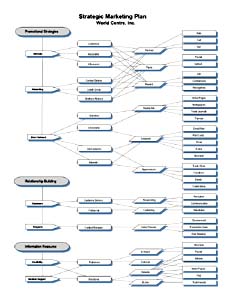
Strategic Marketing Plan


A plan outlining marketing opportunities matched to the resources and abilities of the company.

The most effective way to work with World Centre, Inc. is through the implementation of a strategic marketing plan.  Read more about the benefits of this consulting contract, and if it looks like a good fit for you then apply for consideration.

The Value

A strategic marketing plan is the method by which you make your business grow.  It includes advertising, marketing, sales and customer service.  Having a well deigned marketing plan means your business grows as effectively and efficiently as possible.
By working together on your plan, we can combine cutting edge technology, marketing advances and the nuances of your business into an effective system to increase your customer base and business revenue.

The Components

  • Situation Analysis - The first step is to analyze the core strengths and purpose of the business, identify resources, and objectively consider limitations.
     
  • Recommendations - The plan consists of action steps that will be taken, complete with instruction and explanation.  When appropriate, each step is measured with a budget and expected outcome.  The return on investment (ROI) is carefully projected and monitored.
     
  • Follow Up - In most cases, semi-monthly meetings are scheduled to review the recommendations and results of previous tactics.  For maximum value, recommendations are adjusted, programs initiated or terminated based on performance, and progress reports are discussed.  The greatest value of the Strategic Marketing Plan is delivered in these meetings (done in person or by phone).
     
  • Marketing Tech Support - "Tier one" technical support is provided for the marketing efforts through phone calls and email messages.  In keeping with the importance of your marketing plan, the highest level of service is provided to eliminate concerns about response times or costly delays.
     
  • Reviews and Evaluations - Specific goals are established with time frames and dollar amounts determined according to your business.  As a team, we are dedicated to working together with a common purpose; and we never want to lose sight of that.  By regularly checking our progress, we hold each other accountable and maximize effectiveness.


The Strategy Pyramid

Achieving Strategic Alignment
The Strategy Pyramid places strategy at the top, supported by tactics in the middle, and programmes at the base. Strategy means nothing without tactics and programmes to make it real.

This illustration shows a basic Strategy Pyramid for marketing plans.
The Strategy Pyramid emphasizes the practical importance of building a solid marketing plan structure. Most marketing plans are developed from the top-level strategy first.
Strategy, at the top of the pyramid, is a matter of focusing on specific markets, market needs, and product or service offerings. Tactics follow and set the marketing message and the way it should be transmitted. Programmes, at the base of the pyramid, provide the specifics of implementation. Programmes include specific milestone dates, expense budgets, and projected sales results.


The pyramid and strategic alignment
 
Strategic alignment is essentially matching up your strategy to your tactics and specific programmes, or business activities. The strategy pyramid is a visual tool to help you act on what your plan says you’re going to accomplish.
Strategic alignment sounds simple: bring your activities and spending into logical harmony with your strategy. However, things frequently go wrong. It’s easy to think strategically for a while, and hard to consistently implement all the time. For example, blue-sky strategy is easier than day-to-day implementation.
  • Your key management team has gone away from the office for a day or two to develop strategy. Most groups enjoy that, and most are good at it too. They enjoy the experience and are excited about their accomplishments.
  • They return to the office. The phone’s ringing, emails have gone unanswered, problems come up, opportunities appear. Are they still implementing strategy or do they forget it as soon as they restart the routine?
As you develop your strategy with the pyramid, you design the tactics and implementation programmes you’ll need to make it real. You develop those specific programmes within your milestones so you can track implementation by assigning each programme to a manager, with a budget, and milestone dates.
It is important to track and measure the expense of the programmes for each tactic. Does the emphasis in spending match the emphasis in strategy? If your emphasis is on one tactic, are you spending to match? This process increases the likelihood of implementation.

The illustration shows a strategy pyramid which contains three tactics.


The next illustrations show an expenses chart broken into the tactics of the pyramids, and a partial spreadsheet table of the chart. Managers assigned their budgets to the various program activities to assigned the three tactics.


People do what they like to do. Often they twist their job descriptions around to do what they like doing. This isn’t a bad thing, really, because people are good at what they like; however, it can foil your efforts to create and implement strategy. Use milestones, with dates, budgets, and manager responsibilities, to make sure your daily activities follow your strategic guidelines.
Unfortunately strategic alignment isn’t easy. Companies frequently talk about one strategy and implement another. For example, in the middle 1980s Apple Computer’s strategy was focused on developing desktop publishing as a competitive advantage. The Macintosh was the first computer to integrate laser printing and page layout at popular prices, and Apple had a huge advantage. However, it took several years to make people understand what desktop publishing was, and by the time the message was clear Apple’s managers were tired of it. So while the strategy was desktop publishing the managers focused on multimedia and personal digital assistants instead. Budgeted marketing activities didn’t focus nearly as much on desktop publishing as the strategy dictated.
That was a lack of strategic alignment that failed to support and implement the desired strategy.

The road to a Strategic Marketing Plan

I once read that the difference between a weekend fisherman and a professional fisherman is that the professional fisherman writes down things like the date, water temperature, time, size of fish, the exact spot where he dropped the line, the weather conditions, etc…  Whereas the weekend fisherman will move from spot to spot, try new lures, buy new equipment and wonder why can’t catch many fish.  How does this related to a strategic marketing plan?  Simple.  The professional fisherman tracks and analyzes his results and is therefore able to make better decisions the next time out.
Although the example above is very simple, the solution is rarely that easy.  Now, in order for you to really, completely, fully understand how we at eBoost create strategic marketing plans there are three key elements you will need to know:
1. eBoosts Strategic Methodology
2. eBoosts Strategic Concept
3. One of eBoosts Strategic Tools
First up, we have eBoosts strategic methodology, also know as our strategic problem solving methodology.   In order to solve a problem we have to first have a problem, and we always formulate problems in the form of a question.
Problem:  How does our company increase sales?
Before we can even begin trying to answer this question we need information.  Information is the bread and butter of our strategic methodology and until we have enough of it, we keep collecting it.  So, what is enough?  Enough is 70% Data to 30% Critical Unknowns and Assumptions.
Date – Data is anything we can quantify.  Numbers, percentages etc…
Critical Unknowns – Critical Unknowns are always in the form of a question and questions that make this list are things we absolutely have to know before we can even begin trying to formulate a marketing plan.  For the example above,  a critical unknown would be how many sales do we have a month or year.  This is critical because we can’t accurately increase sales if we don’t know how many sales we currently have.
Assumptions – Assumptions are things we feel or think.  An assumption for the example above might be “I feel like our sales team could be closing more deals”.
An important thing to know is that when we quantify Critical Unknowns and Assumptions they become data.
After we have collected enough information we move to eBoosts Strategic Concept, Theory Focused Planning.  TFP uses Data, Critical Unknowns and Assumptions to help bridge the gap between where we currently are and where we’d like to be.  The chart on top of this page illustrates it much better but imagine a dot in the middle of a large circle.  That dot in the middle represents the perfect answer, the only thing is, it’s unreachable.  But that doesn’t mean we can’t get close to it and that is exactly what we are trying to do.  Why do you think that dot is unreachable?  Because of the ever changing Internal and External Factors that influence it.
Internal Factors
-    Strategy
-    Operational Activities
-    Resources
-    People
External Factors
-    Public
-    Micro Economic Forces
-    Customers
-    Competition
It’s also important to note that when we are collecting this information we are collecting it from the past and present so that we can better plan for the future, only makes sense since we make marketing plans for the future.  To illustrate this we use a Time Continuum and the past is 20/20 hindsight, present is 20/20 insight and future is 20/20 foresight.
The last piece to the puzzle is one of our Strategic Tools, the 3C Model.
The 3C Model was discovered by Kenichi Ohmae, a partner of McKinsey and Company in the mid 1980’s and what he did was study successful Japanese businesses to better understand how they worked and what made them so successful.  What he discovered was that each one of these successful Japanese businesses had perfect balance between their Company, Customers and Competition.  This is where we get the 3C’s and the perfect equilateral triangle.  The triangle itself represents complete balance, that’s why it’s exactly 60 degrees on each side.  Kenichi said that when a company has this perfect harmony and balance between the 3C’s, then and only then can they sustain a competitive advantage.
So how does this tie into how we formulate strategic marketing plans?  Since we have compiled a lot of Data, Critical Unknowns and Assumptions up to this point we can now take that information and see where it falls into the 3C’s.  We might find that we know a lot about our competition and we might be doing things well within our company but we don’t really know our customers so then we know what we need to focus on.  We would then collect more information about the customers, we would test those Critical Unknowns and Assumptions to get data.  If for example you are collecting information and you notice a lot of Critical Unknowns related to your customers then that would be a pretty clear indication that the 3C triangle might not look like a perfect triangle at all.
Now that we collected all this information using our Strategic Methodology and Strategic Concept and have evaluated our current 3C Model to find areas where we can improve, we can finally formulate a sound Strategic Marketing Plan to help us achieve our goals and help balance out our 3C Triangle to ensure our business has a sustainable competitive advantage.